


When It’s Not Just an Itch: Recognizing Vulvar...
We are excited to see so many of you join our FMEP courses. Several of...
0

We are excited to see so many of you join our FMEP courses. Several of you have requested we continue to post more practice SAMPs, so here you go!
SAMP
A 74-year-old man with a 3-year history of Parkinson’s disease presents to your family practice with 6 falls in the past 3 months. He reports intermittent lightheadedness when standing. His wife notes increasing forgetfulness over the past 6 months; she reports that he has forgotten to close the front door and is getting lost when they go on walks together. He has also recently started to report seeing rabbits running around the house. His wife is not sure what to make of these symptoms and thinks he is “seeing things.” Medications include levodopa-carbidopa, pramipexole, sertraline, and chlorthalidone.
On examination:
Supine BP: 140/85 mm Hg, HR 67
Standing BP (1 min): 118/72 mm Hg, HR 70
Standing BP (3 min): 112/70 mm Hg, HR 72
He does not report symptoms during the measurement. (8 points)
Answer: C
Answer: C (Trap: always address reversible/medication causes first)
Answer: True
Answer: True
Answer:
Orthostatic hypotension
Visual hallucinations
Cognitive decline/fluctuations
Answer: Autonomic failure due to neurodegeneration affecting sympathetic nervous system pathways. This leads to impaired vasoconstriction and blunted compensatory tachycardia
Helpful CMAJ Resource:
https://www.cmaj.ca/content/198/12/E444

We are excited to see so many of you join our FMEP courses. Several of...
0
We are excited to see so many of you join our FMEP courses. Several of...
Comments Off on Severe Hypertriglyceridemia: Recognize the Red Flags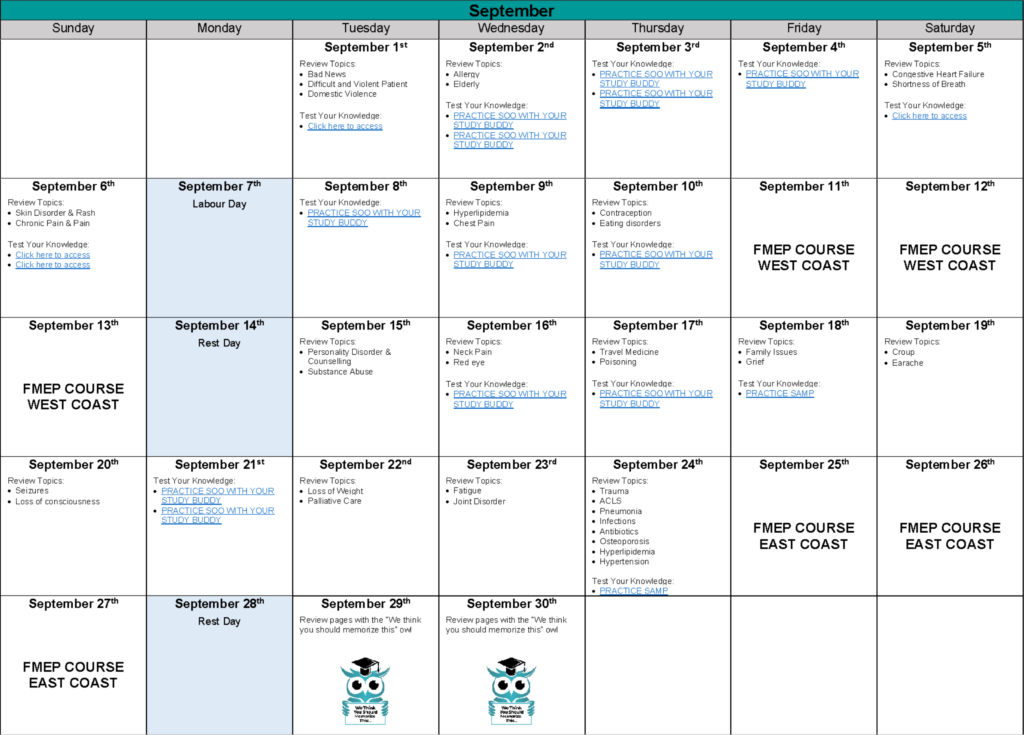
The CCFP exam is quickly approaching, and the FMEP Course is here to help! We...
Comments Off on Put Success on Your Calendar 📅
We are excited to see so many of you join our FMEP courses. Several of...
Comments Off on Burning Feet: Detecting Neuropathy Early